

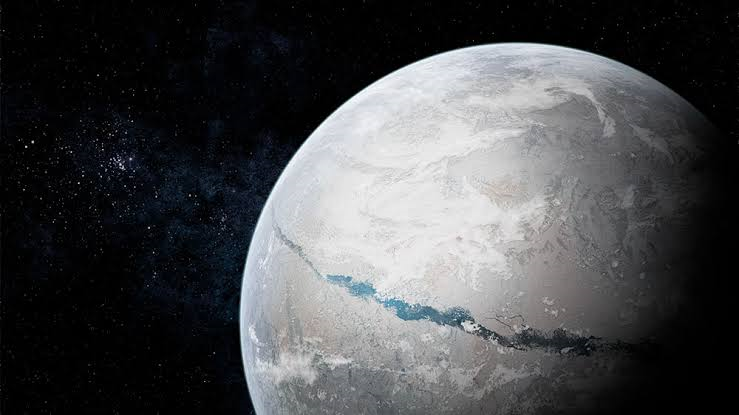
About 700 million years ago, before the onset of macroscopic life, Earth froze over, and for our public lecture on 12th October, UCC’s Dr Heda Agić will look at how life on Earth survived these conditions.
During the Snowball Earth glaciations, ice may have reached the equator, sealing the oceans beneath a frozen lid for millions of years. The large image is a rendition of the Earth during these Snowball glaciations, when our planet would have looked very similar to the solar system’s icy moons.
Moreover the cold wasn’t the only challenge, as for most of the two billion years before animals appeared, Earth had very little oxygen. Yet life made it through, including our own ancestors — the complex cells of eukaryotes and early multicellular forms that would eventually give rise to plants, fungi and animals.
Dr Heda Agić (small image) lectures in UCC’s School of Biological, Earth and Environmental Sciences, and will address the question, how did life survive? And does the answer provide any clues to one of the biggest questions in science: could life exist in the ice-covered oceans of moons like Europa and Enceladus?

Where and when: UCC’s Ashley Cummins building (formerly known as Civil Engineering, near College Road entrance to the main campus). 8 pm, Monday 12th Oct 2026. Please arrive 10 minutes early – or earlier if you wish to join our Club. This is a public lecture, all welcome. For UCC map go to Calendar