

Claims that signs of life have been detected in the universe have so far proved erroneous — but November’s speaker, Dr Samuel Beiler (pictured below), will focus on the careful scientific process that may eventually allow for such claims to be believable.
He will explore this through the lens of phosphine (PH3) — a molecule found on Earth, Jupiter, and Saturn, and controversially claimed to be a potential biosignature found on Venus. An expert in the on-going mystery of this molecule, Dr Beiler will describe new work from the James Webb Space Telescope which has opened a new chapter in the study of phosphine by looking at the coldest brown dwarfs. These objects, which fall in the grey area between planets and stars, act as ready-made celestial laboratories that have twice shattered our understanding of phosphine. Come and hear the twists and turns of scientific discovery and the open mysteries that still lie ahead of us.
Samuel is calling his talk “The Tangled Webb of Phosphine Chemistry, and why it matters in the search for life”.

The speaker: Samuel Beiler is a post-doctoral researcher at Trinity College Dublin, where he studies the dynamic atmospheres of brown dwarfs and exoplanets. He published some of the first brown dwarf observations from the James Webb Space Telescope, and is an expert in the on-going mystery of the molecule phosphine. Samuel Beiler professional website.
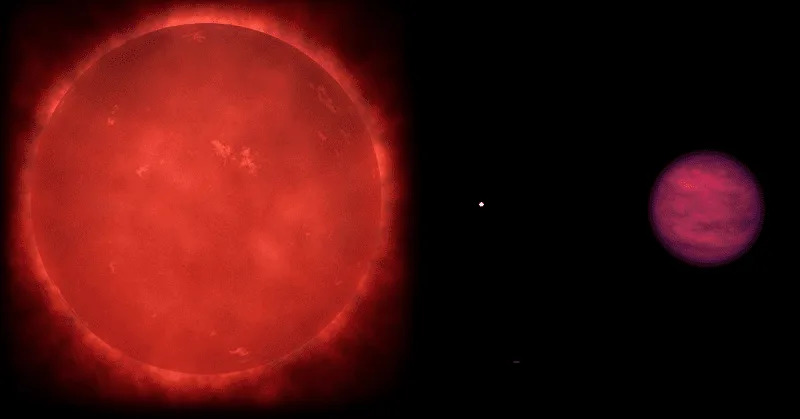
Main image: Shematic showing Wolf 1130, a triple system with a M-dwarf and white dwarf pair at the center, and a brown dwarf orbiting much further out. This system is the first detection of abundant phosphine outside the solar system. Credit Adam Burgasserts.
Where and when: UCC’s Ashley Cummins building (formerly known as Civil Engineering, near College Road entrance to the main campus). 8 pm, Monday 10th November 2025. Please arrive 10 minutes early – or earlier if you wish to join our Club. This is a public lecture, all welcome. For UCC map go to Calendar