

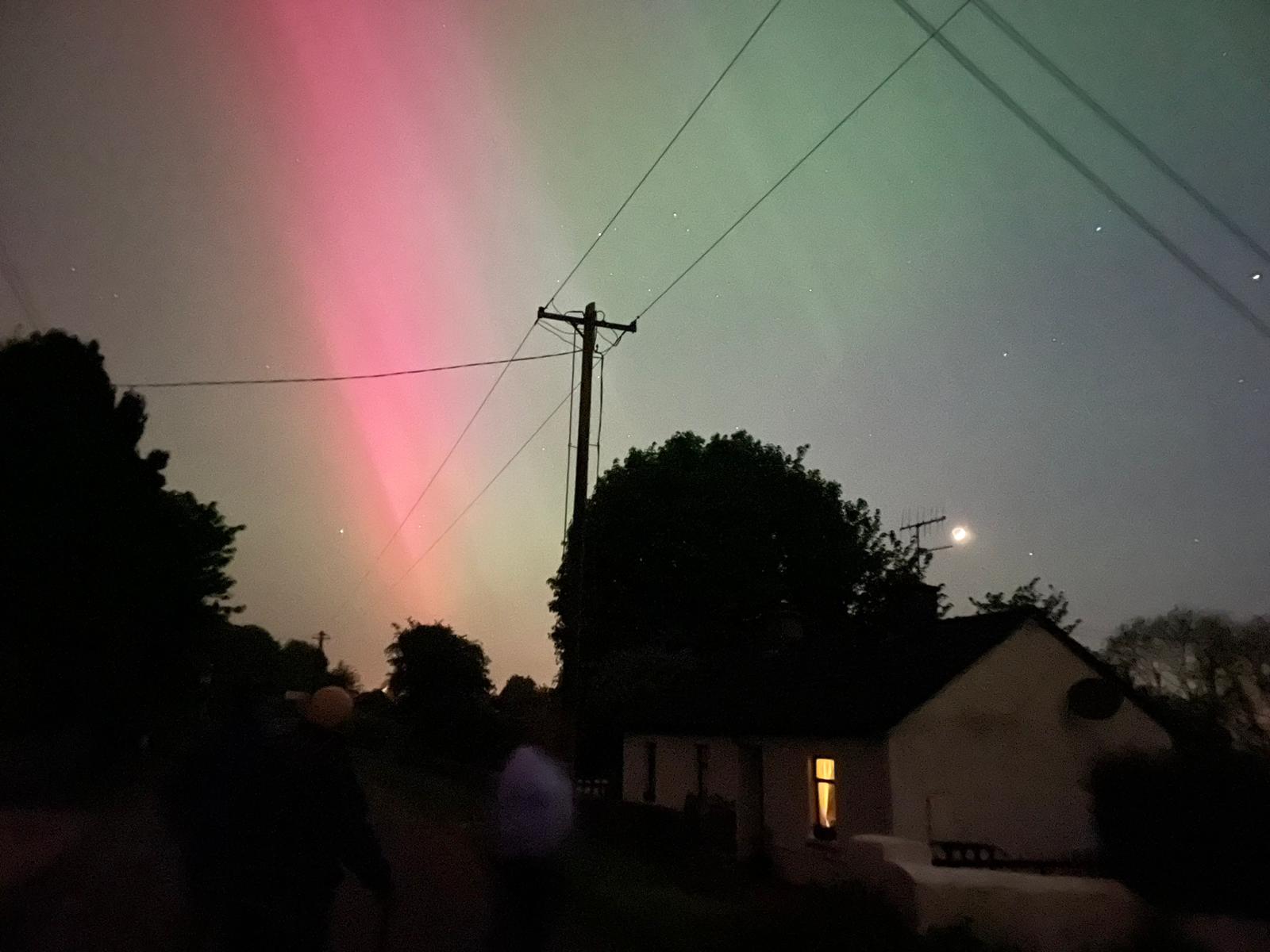
Very few Cork Astronomy Club members saw the aurora of 10th May 2024, due to clouds. This photo was taken at 11 pm in North Cork 6 km E of Mitchelstown. Here the sky was clear for several hours. It exaggerates slightly the aurora’s depth of colour as perceived by the human eye, though the exaggeration is less pronounced, I think, than the majority of aurora photos I’ve seen from that night. Peter Household
Because camera sensors work differently from the human eye photographic images can look different as against when viewed by the naked eye. In the human eye your eye registers the photons of light as they hit your eyeball and travel down the optic nerve to your brain, thus the light is registered as it passed through. A camera sensor however works differently, as long as the shutter is open and light is hitting the sensor it accumulates the light. Thus on a long exposure the sensor will gather more light than is possible by the human eye resulting in a different (better?) image than the naked eye. Thus cameras can be used to image fainter objects which may not be visible to the human eye.
Declan Foley