

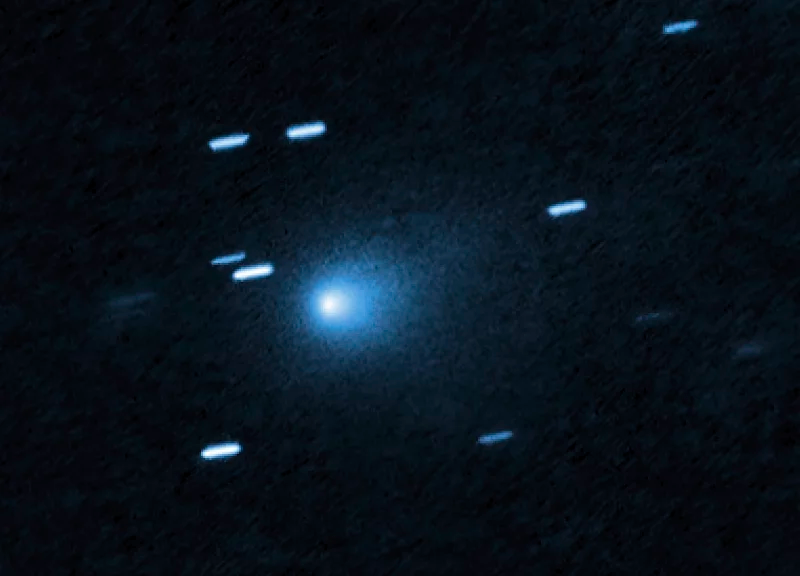
Right! You’ve probably noticed that over the past few weeks, the newly detected object 3I Atlas has set social media on fire. Imaginative theories, conspiracy chatter and outright misinformation have taken over. Add in the swarm of AI-generated videos and wild claims, and suddenly half the internet thinks we’re starring in the next sci-fi blockbuster. Madness!
A big part of the “alien spacecraft” narrative began when Avi Loeb, a Harvard theoretical astrophysicist known for his work on black holes, the early universe and interstellar objects, publicly shared his thoughts about Atlas. Loeb is a respected scientist with a long academic track record, but some of his more recent ideas, especially those involving possible alien technology, have stirred controversy. Many astronomers argue his conclusions leap far beyond the available evidence. If his name sounds familiar, it’s because he previously made headlines for suggesting that the interstellar object ‘Oumuamua might be artificial.
Few days ago, I attended a live youtube video of a Greek astrophysicist (MSc Honours in Astrophysics, Queen Mary University of London) Named Pavlos Kastanas, who has provided a clear and scientifically grounded explanation of the object’s nature and behavior and to remind us that not everything flying through space is here to invade Earth.
I reached out to him asking permission to translate and share his work on our website and he kindly agreed. This is his work :
The Timeline
On July 1, 2025, a new object was detected in the sky by a telescope from the ATLAS system in Chile. Its astonishing speed and trajectory revealed that it did not originate from our solar system. But what exactly is this object, and what do we know about it today?
About two weeks after the detection of this new interstellar visitor, a paper was published by Professor Avi Loeb and his collaborators titled “Is the Interstellar Object 3I/ATLAS Alien Technology?” Since then, countless articles and videos have appeared exploring this possibility, creating a whirlwind of speculation where it’s difficult to separate fact from fiction. However, before we dive into the alien-technology scenario, let’s first look at the basic characteristics of this new visitor.
3I/ATLAS is the third interstellar object we have discovered, after the enigmatic ‘Oumuamua, which we covered in an earlier video, and the comet 2I/Borisov. Like 2I/Borisov, 3I/ATLAS exhibited a coma almost from the start, which is why it was classified as a comet. The coma is the characteristic white cloud surrounding a comet’s icy nucleus. It forms when the comet approaches the inner solar system. The icy materials heat up and sublimate, meaning they turn directly from solid to gas due to the increased temperature. The substances that typically sublimate include water, carbon dioxide, and carbon monoxide. As these materials sublimate, they also carry along other surface particles in the form of dust, giving the coma its fuzzy appearance.

At the time of its discovery, 3I/ATLAS was approximately 4.5 astronomical units from the Sun, a distance roughly similar to that of Jupiter. Its orbit is hyperbolic, meaning it is open—an indication that it originates from beyond our solar system.
The most striking feature, however, was its incredible speed at the time of discovery: 220,000 kilometers per hour! This is far faster than the previous two interstellar visitors and 3.5 times faster than Voyager 1, which is traveling at escape velocity from our solar system.
This means that 3I/ATLAS will not be captured by the Sun’s gravity; the Sun merely bends its trajectory slightly. Interestingly, its orbit deviates only about 5 degrees from the plane of the ecliptic, meaning it moves almost parallel to the plane of our solar system.

On October 3, 2025, 3I/ATLAS passed relatively close, by astronomical standards to Mars, at a distance of 28 million kilometres. On October 29, it reached perihelion, the closest point to the Sun, at 1.4 astronomical units, placing it between the orbits of Mars and Earth. At this point, its speed exceeded 245,000 kilometres per hour. If it continues its journey unimpeded, it will pass 54 million kilometres from Jupiter in March 2026.
The comet was visible from Earth until September. Unfortunately, in October it could not be observed due to its position near the Sun. However, it is expected to reappear in the sky in early November, when it will again be studied by telescopes. It will not come close to Earth, with the closest approach being 1.8 astronomical units on December 19, 2025.
Observations of 3I/ATLAS in July showed a body with a coma, but without a tail. Its nucleus size is somewhat uncertain because it is hidden by the coma, but estimates suggest a medium-sized nucleus, ranging from 0.36 to 5.6 kilometers.
Spectral analyses of the comet’s coma, conducted by both ground-based and space telescopes, including Hubble, James Webb, and SphereX, revealed the presence of carbon dioxide, water, and carbon monoxide, which are typical for comets. What was unusual, however, were the relatively small amounts of water and carbon monoxide, indicating that the coma is primarily composed of carbon dioxide. This may tell us something about the conditions the comet encountered during its journey. Typically, carbon monoxide sublimates first, followed by carbon dioxide, and finally water. Based on this, we would normally expect to detect more water. In the case of 3I/ATLAS, the reduced water levels may indicate stratification of materials that prevents water from sublimating. Alternatively, the abundance of carbon dioxide could provide clues about the origin and formation of 3I/ATLAS, suggesting it may have formed in a region of its home planetary system where carbon dioxide ice is stable.
Origin and Age
Speaking of its planetary system brings us to perhaps the most striking feature of 3I/ATLAS: its origin. Where did this peculiar visitor come from, and how old is it? It is impossible to determine its exact parent star, since the object has experienced gravitational interactions with other stars during its journey, making its orbit complex.
However, according to simulations of its trajectory, the comet appears to have originated from either the thin or thick disk of the Milky Way. The thick disk is a more diffuse region surrounding the dense thin disk, which is where our solar system resides, and is mostly composed of older, metal-poor stars. If 3I/ATLAS indeed comes from this region, it gives us a first-ever opportunity to study an ancient body from that part of the galaxy up close. Studies published on its age give a broad range of estimates, but converge on the conclusion that it is extremely old, likely over 7 billion years! This means that this mysterious traveler may have begun its epic journey long before our solar system even formed.


(M. Hopkins/Ōtautahi-Oxford team)
In its spectrum, in addition to the sublimated gases we discussed earlier, nickel, cyanide, and more recently iron have also been detected. These findings are common for comets. However, the nickel-to-iron ratio is very different from what is usually observed. Specifically, iron appears in much smaller amounts than nickel.
This difference began to decrease as the object approached the Sun, suggesting that the iron was likely trapped in other compounds and released as temperatures increased. Interestingly, nickel appeared relatively early, when 3I/ATLAS was still at distances where sublimation is unlikely. This indicates that the appearance of nickel is probably due to the breaking of chemical bonds in compounds containing it, such as nickel carbonyl.
Common Misunderstandings
Let’s now look at the claims about extraterrestrial intelligence. These claims usually point to unusual features of the comet as evidence of alien technology. Let’s examine them one by one.
1. It has no tail.
Comet tails point away from the Sun, as the solar wind and radiation push the dust and sublimated materials outward. Early observations of the comet in July 2025 indeed did not detect a clear tail. It’s worth noting that, initially, Loeb even questioned the nature of the coma. Eventually, however, the tail became clearly visible in an impressive image from the Gemini South telescope in Chile, taken on August 27.

(International Gemini Observatory/NOIRLab/NSF/AURA/Shadow the Scientist)
At the end of August, a tail pointing in the opposite direction, toward the Sun, was also detected. This is a rare phenomenon that sometimes occurs when the Sun-facing side of the comet heats up. The increased temperature creates jets of gas and dust that are ejected toward the Sun. Gradually, however, these materials are also pushed toward the main comet tail by the solar wind and this is exactly what was observed with 3I/ATLAS.
2. It moves in an unusual path, suggesting an exploratory mission.
3I/ATLAS moves almost parallel to the plane of our solar system, passing relatively “close” to Mars, Venus, and Jupiter. But this should not be surprising. The comet was discovered by the ATLAS system (Asteroid Terrestrial-impact Last Alert System), which consists of five telescopes around the globe designed to detect potentially dangerous asteroids. Essentially, ATLAS is a planetary defense system. And where does it mainly search for potentially hazardous objects? Naturally, near the plane of the solar system, because that’s where the vast majority of asteroids are located!
It’s also important to note that the actual number of interstellar objects traveling through our galaxy is much, much larger than the number of stars and planets. Researchers estimate there are at least 10²¹–10²⁴ bodies larger than 100 meters freely roaming the Milky Way. During the early stages of a planetary system, many of these objects escape due to collisions and gravitational interactions. Additionally, a close passage of another star or giant planet can give them escape velocity from their system. It’s estimated that currently, about 10,000 interstellar objects larger than 100 meters exist inside Neptune’s orbit.
So far, we’ve only detected three interstellar visitors, all in the past decade—not because they are rare, but because only now do we have telescopes capable of such detailed observations. For example, 1I/’Oumuamua wasn’t detected while approaching our solar system, but only as it was leaving.
Regarding 3I/ATLAS’s approaches to planets, we must be careful how we interpret “close” in astronomical terms. It can give the illusion that 3I/ATLAS is following a planet like a satellite, which is not the case. Its closest approach was to Mars on October 3, 2025, at 0.19 astronomical units (28 million kilometers). At this distance, Mars would appear as just a very bright star. Its closest approach to Venus will be 0.65 AU (97 million km)—slightly less than the Venus-Sun distance—while its approach to Jupiter will be 0.36 AU (54 million km), roughly the distance of Mercury from the Sun.
3. It moves unusually fast.
How do we explain the comet’s incredible speed? It escaped from another planetary system, so in addition to its own velocity, it carries the velocity of its home system. For context, neighbouring stars differ in speed by roughly 100,000 km/h, while the Sun’s velocity relative to stars in the thick disk can exceed 300,000 km/h. These velocities add to interstellar objects, so detecting such speeds is not surprising. Interactions with other stars along the way can also increase the speed of interstellar visitors.
As for 3I/ATLAS’s motion, nothing particularly unusual has been observed. Comet motion is affected by two main factors:
- Gravitational pull from the Sun and other bodies.
- Jets from sublimating materials on the comet’s surface, which push the comet in the opposite direction according to Newton’s third law.
So, while there are variations in velocity, these are expected and observed in all comets. Some reports or videos mentioning “course changes” are likely referring to this normal behavior, not sudden maneuvers or artificial adjustments.
4. It turned “greener.”
During the lunar eclipse on September 7, two photographers (Michael Jäger & Gerald Rhemann) captured 3I/ATLAS with a slightly greenish hue. These images are real but are broad-spectrum, processed color images, not spectroscopic data showing specific emission lines. Visually, the comet may have appeared slightly greener due to increased activity and more pronounced cyanide and dust, giving cameras a subtle green tint. Scientifically, however, this “greening” is not confirmed. Comets appear green when C₂ (diatomic carbon) is emitted. In this case, C₂ has not been detected spectrally. If future spectra near perihelion show C₂, then the “greening” will be confirmed.
5. It suspiciously hid behind the Sun.
It was claimed that at perihelion (October 29), the comet “hid” behind the Sun, preventing observations. Loeb even joked that it might perform manoeuvres or release probes.
In reality, the comet was near the Sun in the sky, not behind the solar disk. The minimum angular distance between the Sun and 3I/ATLAS was 2.59° on October 21, 2025, when the comet was 2.4 AU from Earth. This corresponds to about five full Moons. At perihelion, the distance increased to 12.8°, or at least 25 Moons.
For faint objects, we generally need 20–30° angular separation from the Sun to observe them with sensitive telescopes. Therefore, it could be seen again in early November. Meanwhile, the GOES-19 coronagraph captured it on October 18, and it was observable until October 24. Observations were also made by other ESA and NASA missions, while ground-based observers could not see it from Earth.

6. Why are the space agencies “silent”?
There is no “silence.” The ESA has published several articles about 3I/ATLAS. In fact, during the comet’s passage near Mars in early October, ESA attempted to photograph it using the Trace Gas Orbiter and Mars Express, both orbiting the Red Planet.Mars Express failed to detect the comet because its maximum exposure time is only 0.5 seconds. The Trace Gas Orbiter, however, was able to spot it. It’s important to note that these spacecraft are not designed to observe faint objects, but rather the much brighter surface of Mars.

During November, 3I/ATLAS will also be observed by ESA’s JUICE mission from a distance of 0.43 astronomical units. JUICE, which has been presented in detail on the Astronio channel, is en route to the icy moons of Jupiter.
Regarding NASA, the ATLAS system is their project, meaning they fund it, while the data is managed by the University of Hawaii, which is part of the USA. So, we owe our knowledge of this object and its unusual orbit to NASA. During the comet’s passage near Mars, NASA’s Mars Reconnaissance Orbiter (MRO) took photographs, though they have not yet been released. These are expected to be higher resolution than ESA’s images, as MRO has superior imaging capabilities. Additionally, though not officially confirmed, two cameras on the Perseverance rover may have captured images of the comet. The first shows a blurry spot where the comet should be, and the second shows a elongated shape, which sparked conspiracy theories. However, both images were taken with long exposure photography

Why haven’t we received confirmation from NASA about these photos yet, and why haven’t the MRO images been released?
For a reason completely unrelated to space: the U.S. government shutdown! Only the absolutely essential personnel are working in U.S. federal agencies because the government hasn’t passed the budget through Congress. Unfortunately, this situation continues to this day. Consider this: if the shutdown had occurred at the time of the comet’s discovery, July 1, 2025, conspiracy theories would have run wild, claiming NASA stayed silent when an interstellar object was detected. If it had happened two weeks later, during the publication of Loeb’s paper, the same connection would have been made. If it had occurred at perihelion, on October 29, instead of during its passage near Mars, again conspiracists would have jumped on it. And even if it had occurred at the comet’s closest approach to Earth in December, the same disconnected narrative would have been made. Once the budget passes and the government shutdown ends, the necessary personnel will release the data publicly.
7. Does it have a strange shape and its own light?
Among other things, baseless rumors circulated about the object’s shape and brightness. The “cigar shape” speculation likely came from misinterpretations of the Perseverance rover images. Even Loeb explains on his blog that if it is indeed 3I/ATLAS in those images, its elongated appearance is due to multiple consecutive exposures or long-exposure photography.
The misconception about it being a “self-luminous object” comes from Loeb’s initial interpretation that the comet had no coma. If the comet truly had no coma and emitted that much light, it would indeed imply a mysterious or very large object, over 20 kilometers across. However, the coma, with its frozen particles and dust, reflects sunlight like clouds, making comets appear much larger and brighter than an asteroid.
Another misinterpretation claims the object is multicolored. This likely arises from a Gemini North image, where the comet’s path was photographed through three different color filters (red, green, blue) at different times.

International Gemini Observatory/NOIRLab/NSF/AURA/K. Meech (IfA/U. Hawaii)
Image Processing: Jen Miller & Mahdi Zamani (NSF NOIRLab)
There is, however, something truly unusual about the comet: the polarization of the light reflected by its coma. The way its materials polarize light resembles more the small icy bodies beyond Neptune’s orbit than the usual “weathered” appearance of comets. This is something that will need to be confirmed from mid-November onward, when the object will again be observable with our large telescopes. If confirmed, it would indeed indicate a special type of comet, different from those we typically observe in our solar system.
8. Unusual ≠ Extraterrestrial Intelligence
Strange and unusual does not equal extraterrestrial intelligence. To consider something as evidence of alien intelligence, it cannot merely be unexplained. This thinking is reminiscent of how ancient humans attributed natural phenomena to “easy” supernatural explanations: Jupiter hurled the lightning, Enceladus caused earthquakes, and Neptune the storms. Later, in the Middle Ages, everything was ascribed to God, the Devil, angels, or demons. Unfortunately, invoking extraterrestrial intelligence whenever we encounter something we cannot immediately explain is a continuation of this simplistic and magical way of thinking.
Moreover, rushing to such explanations makes us miss the opportunity to truly understand what this object is made of and how it formed. We risk losing the chance to learn about the conditions that existed in another region and another era of our galaxy. After all, it could be a new type of comet or even a completely new class of object.
We should also be mindful of a common logical fallacy: if an object does not meet all the criteria for a certain category, that does not mean one can arbitrarily place it in any other category. If we want to be rigorous in defining the “comet” category, based on specific material ratios, we must exercise the same rigor when considering the “starship” category.
In addition, throughout the history of astrophysics, there have been countless cases where we thought we had discovered aliens, only to find natural phenomena were responsible. Even many objects whose existence is now taken for granted were once interpreted as evidence of alien civilizations. Pulsars, quasars, Tabby’s Star, and others were at times seen by some as signs of extraterrestrial intelligence (see video: When We “Discovered” Aliens).
What characteristics would an object need to indicate extraterrestrial intelligence?
Some indicative traits we might expect from an alien craft include:
A. High speed – potentially some fraction of the speed of light (>1% of c). The entry speed of 3I/ATLAS into our solar system was just under 209,000 km/h (0.019% of c). While this seems fast, at this speed the object would need ~22,000 years to reach the nearest planetary system. For comparison, NASA’s Parker Solar Probe reached at least three times this speed—692,000 km/h—while approaching the Sun.
B. A solid, compact body – potentially with visible energy emission along an axis (propulsion). Additionally, the second law of thermodynamics implies inevitable losses.
C. Acceleration not explained by gravity or outgassing.
D. Emission of radiation carrying information, at any wavelength.e. Any behavior indicating technological activity, such as maneuvers or release of probes/devices.
E. Any behavior indicating technological activity, such as maneuvers or release of probes/devices.
Logical Fallacies Observed
Petitio Principii (Begging the Question)
A recurring fallacy in discussions of 3I/ATLAS is petitio principii, or assuming the conclusion within the premise.
As noted in the case of ‘Oumuamua, Loeb claimed that its unusual speed and trajectory—nearly perpendicular to the solar system—were signs of intelligence, implying it might be camouflaged to hide its origin. Yet for 3I/ATLAS, which has the opposite traits (high speed and orbit nearly parallel to the planetary plane), Loeb again interprets it as evidence of intelligence.
This approach harms science communication, giving social media outlets and influencers fodder to spread sensationalized stories.
Moving the Goalpost
Another recurring fallacy is the “moving the goalpost” strategy. Loeb suggested 3I/ATLAS might be an alien craft if:
- It had no coma → discovered it does.
- It had no tail → discovered it does.
- It was gigantic (>20 km) → actually <5.6 km.
Despite these points being disproven, he continues to argue his initial hypothesis.
Damage to Science Communication
Some additional serious issues I have identified regarding the way the existence of the third interstellar visitor has been communicated to the public are the following:
A. Premature conclusions – Less than 15 days after discovery, Loeb published a paper suggesting extraterrestrial intelligence. He is well-known for such unconventional interpretations.
B. Amplification of one voice – Although over 100 papers exist on the comet, only Loeb’s team suggests an alien craft. His hypothesis is amplified because it is exotic and “popular,” not because it is better supported.
C. Misrepresentation of context – Loeb’s paper itself is described as hypothetical, an “educational exercise,” noting the most likely scenario is a comet. This is often omitted in media coverage.
The SETI Institute Statement
SETI, which has invested heavily in searching for extraterrestrial intelligence, provides a grounded assessment:
- Behaves like a comet: Has a solid nucleus releasing dust and gas, creating a coma and tail.
- No signs of technology: No signals, propulsion, or artificial structures detected.
- Natural variations: Comets differ depending on their origin. Early activity in 3I/ATLAS is unusual but within natural possibilities.
Occam’s Razor: The simplest explanation, requiring the fewest assumptions, is that 3I/ATLAS is a comet, not a spacecraft.
“What if it is an alien craft?”
Can we rule it out 100%? No. Could it be a spacecraft deliberately mimicking a comet? Possibly, but this is a highly speculative argument and not grounded in evidence. Scientific hypotheses must be based on observable evidence, not “why not?” or “wouldn’t it be nice if…?”
If it were an alien craft, we would report it with full scientific documentation of the data supporting that claim.
Focus on the Science
Objects like 3I/ATLAS are fascinating because of their distant origins. Planets, asteroids, and comets in our solar system formed in the same “neighborhood,” from similar materials. Interstellar visitors like 3I/ATLAS give us the opportunity to learn about entirely different planetary systems, potentially very far away and very different from ours. Instead of inventing aliens at every mystery, we should appreciate the chance to study the remnants of planetary systems across space and time.
Useful Sources:
The coma of 3I/ATLAS consists mainly of carbon dioxide:
https://www.universetoday.com/articles/3iatlass-coma-is-largely-carbon-dioxide
A very good article explaining the different sublimation points of gases in comets, combined with the characteristics of 3I/ATLAS:
https://bigthink.com/starts-with-a-bang/spherex-jwst-comet-3i-atlas/
The SETI Institute article:
https://www.seti.org/news/visitors-from-the-stars-understanding-comet-atlas-without-the-hype/
Paper showing that iron was found in the comet and the Ni/Fe ratio decreases:
https://arxiv.org/abs/2509.26053
Paper estimating that there are around 10,000 objects the size of ‘Oumuamua or larger within Neptune’s orbit:
https://arxiv.org/pdf/2407.06475
ESA article about the images it received from the comet, including a very good infographic showing its path and key points of its trajectory:
https://www.esa.int/Science_Exploration/Space_Science/ESA_s_ExoMars_and_Mars_Express_observe_comet_3I_ATLAS
About the Author Pavlos Kastanas :
‘ I was born in 1982 and grew up and live in Athens. I studied Physics at the University of Athens and then completed a Master’s degree (MSc) in Astrophysics at Queen Mary, University of London, where I graduated with distinction.
I have been involved for many years in education, particularly in private higher education, as a lecturer at the University of Derby, teaching undergraduate courses in the physical sciences (Physics, Mathematics, Fluid Mechanics, Thermodynamics). In the past, I also worked in secondary education as a Physics-Chemistry teacher at the Athens College.
Besides teaching, I have worked on the scientific editing of children’s science books, music, website design, and application design.
In May 2017, I created the YouTube channel Astronio with the aim of bringing Astrophysics closer to the Greek public. In the fall of 2018, I designed and taught a series of Astronomy courses for children at an educational center in Athens, and a few months later I launched the Astronio Bar Quiz, astronomy and game nights in bars in Athens, as well as in other cities in Greece. The Astronio Bar Quiz events continue successfully, in increasingly larger venues, to this day.
In December 2020, my first book, titled “To the Stars: A Magical Journey into the World of Astrophysics”, was published. The book is a popular introduction to the most important topics in Astrophysics, without requiring prior knowledge of the subject. The public response was extremely positive, both in terms of reviews (4.8/5 on Goodreads) and sales, with over 10,000 copies sold within the first eight months of publication.
In the summer of 2021, in collaboration with Yiannis Roussos, I designed an event that combines Astrophysics and Music, titled “Children of the Stars”. This event travelled to Syros, Volos, Thessaloniki, and Athens and was warmly received by the public.
In the fall of 2021, the website Astronio.gr was redesigned to additionally function as a portal for astronomy news.
As part of my science communication work, I have given talks at TEDx at the Technical University of Crete, Aristotle University of Thessaloniki, the Athens Science Festival, Mediterranean College, Athens College, the Eugenides Planetarium, and other venues.
In the fall of 2019, I had the honor of receiving the EPIS2 Science Communication Award from the educational organization “Science Communication – SciCo,” which organizes the Athens Science Festival. In February 2025, I received the Science Outreach Award from Mediterranean College.
The Astronio Channel
I created the Astronio channel in May 2017 to bring astronomy and the physical sciences closer to the Greek public. Recent scientific discoveries are particularly impressive and have radically changed the way we view the world. However, I am particularly concerned that a vast portion of both the Greek and global public is completely unaware of this bright new world unfolding before our eyes.
I believe that one of the main goals of science communicators should be to show people the great truth about humanity’s place in the universe: Earth is our tiny home in an unimaginably vast universe, and the unity of humanity is essential for its survival and development. Science shows the way, as long as we have the courage and enthusiasm to follow it. I hope this channel serves as a small building block in the larger framework of science communication, allowing more people to discover the beauty of the physical sciences, and especially Astrophysics. ‘
And a personal note: I highly recommend that anyone who can use Google Translate to take a look at Pavlos’ website https://www.astronio.gr/ . He posts fascinating articles that are explained in a simple, clear, and easy-to-understand way.
I want to thank Pavlos again for allowing to repost his work in our website.
Clear Skies